
This paper introduces the unnatural amino acids m-Abc2K and o-Abc2K as nanometer-sized building blocks for the creation of water-soluble macrocycles with well-defined shapes. m-Abc2K and o-Abc2K are homologues of the nanometer-sized amino acid Abc2K, which we recently introduced for the synthesis of water-soluble molecular rods of precise length. [J. Am. Chem. Soc. 2007, 129, 7272]. Abc2K is linear (180°), m-Abc2K creates a 120° angle, and o-Abc2K creates a 60° angle. m-Abc2K and o-Abc2K are derivatives of 3’-amino-[1,1’-biphenyl]-4-carboxylic acid and 2’-amino-[1,1’-biphenyl]-4-carboxylic acid, with two propyloxyammonium side chains for water solubility.

Abstract
This paper introduces the unnatural amino acids m-Abc2K and o-Abc2K as nanometer-sized building blocks for the creation of water-soluble macrocycles with well-defined shapes. m-Abc2K and o-Abc2K are homologues of the nanometer-sized amino acid Abc2K, which we recently introduced for the synthesis of water-soluble molecular rods of precise length (J. Am. Chem. Soc. 2007, 129, 7272). Abc2K is linear (180°), m-Abc2K creates a 120° angle, and o-Abc2K creates a 60° angle. m-Abc2K and o-Abc2K are derivatives of 3′-amino-(1,1′-biphenyl)-4-carboxylic acid and 2′-amino-(1,1′-biphenyl)-4-carboxylic acid, with two propyloxyammonium side chains for water solubility. m-Abc2K and o-Abc2K are prepared as Fmoc-protected derivatives Fmoc-m-Abc2K(Boc)-OH (1a) and Fmoc-o-Abc2K(Boc)-OH (1b). These derivatives can be used alone or in conjunction with Fmoc-Abc2K(Boc)-OH (1c) as ordinary amino acids in Fmoc-based solid-phase peptide synthesis. Building blocks 1a−c were used to synthesize macrocyclic “triangles” 9a−c, “parallelograms” 10a,b, and hexagonal “rings” 11a−d. The macrocycles range from a trimer to a dodecamer, with ring sizes from 24 to 114 atoms, and are 1−4 nm in size. Molecular modeling studies suggest that all the macrocycles except 10b should have well-defined triangle, parallelogram, and ring shapes if all of the amide linkages are trans and the o-alkoxy substituents are intramolecularly hydrogen bonded to the amide NH groups. The macrocycles have good water solubility and are readily characterized by standard analytical techniques, such as RP-HPLC, ESI-MS, and NMR spectroscopy. 1H and 13C NMR studies suggest that the macrocycles adopt conformations with all trans-amide linkages in CD3OD, that the “triangles” and “parallelograms” maintain these conformations in D2O, and that the “rings” collapse to form conformations with cis-amide linkages in D2O.
SOCIAL MEDIA
Connect with us and stay updated by following our social media channels.
Latest Briefings from our Knowledge Center
Press Releases, Industry News, Articles, and Technical Content

CPC Scientific, a premier peptide and oligonucleotide-focused Contract Research, Development, and Manufacturing Organization (CRDMO) and a wholly owned subsidiary of Medtide Inc. (HKEX: 3880.HK), is pleased to announce that its parent company Medtide Inc. has recently received certification through EcoVadis, a global leader in business sustainability assessments.
CPC Scientific, a premier peptide and oligonucleotide-focused CRDMO and a wholly owned subsidiary of Medtide Inc. (HKEX: 3880.HK), today announced that its Hangzhou-based CGMP manufacturing facility, Chinese Peptide Company, has successfully completed the Drug Master File (DMF) filing for its self-developed Tirzepatide active pharmaceutical ingredient (API) with the U.S. Food and Drug Administration (FDA) under DMF number 043979.

CPC Scientific had a fantastic time connecting with partners this year at DCAT Week 2026. See our standout highlights from New York, featuring generic API scale-up, the 98th DCAT Annual Dinner, and more...
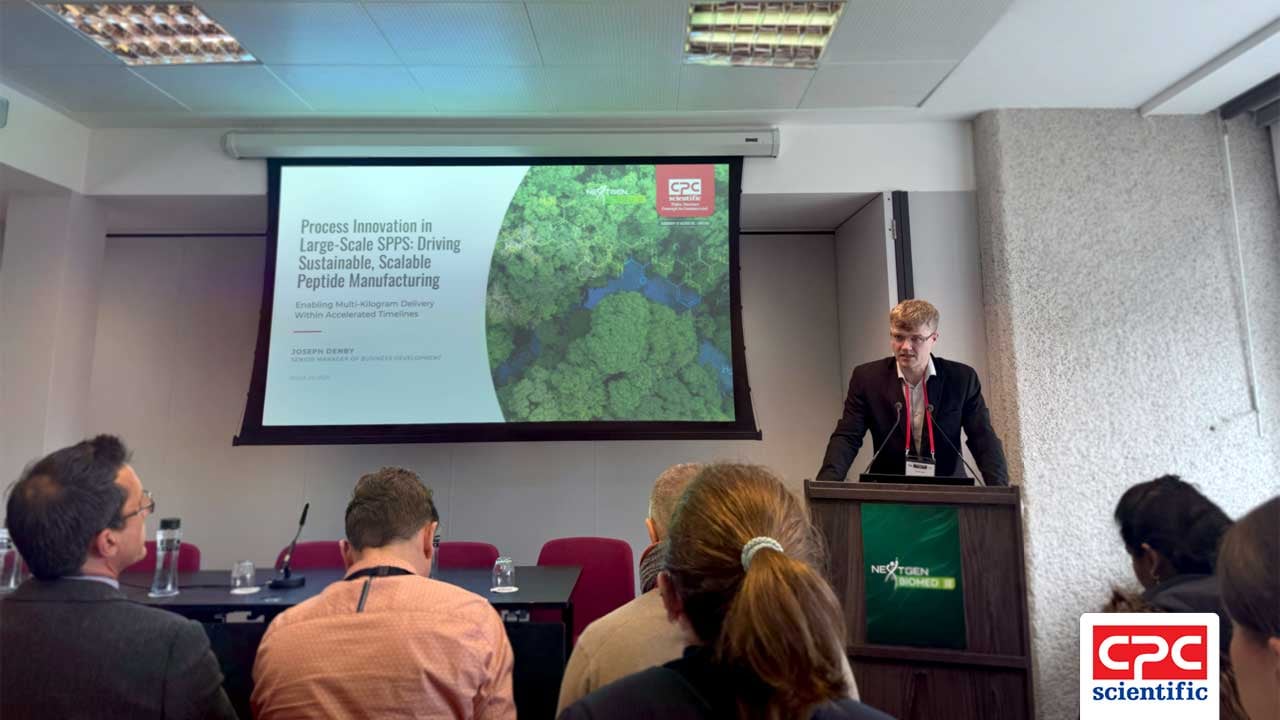
Catch CPC Scientific's key highlights from NextGen Biomed 2026, where we showcased how our advanced process design is accelerating production timelines and cost efficiency for greener TIDES manufacturing at scale...

Delivery of polypeptides in multi-kilogram quantities within commercially competitive timelines is extremely challenging, especially when coupled with a desire to minimize environmental and economic impact. This case study explores how CPC Scientific’s advanced process improvements and efficiencies within solid-phase peptide synthesis (SPPS) have enabled multi-kilogram delivery of a pharmaceutically-relevant decapeptide within a challenging timescale, driving sustainable and cost-saving production for the client.

As 2025 draws to a close, we want to extend our heartfelt thanks to our partners and colleagues around the world! Your trust and collaboration enabled CPC Scientific to make meaningful progress across our CDMO thought leadership, operational scale, and global business milestones this year. Explore featured highlights and resources from the year to see how our people, partners, and platforms drove innovation and impact throughout 2025.

President Theresa Cheng spoke to PhD students at Weill Cornell Graduate School, sharing industry insights and exploring how academic research today can translate into tomorrow’s cutting-edge healthcare leadership.
Our team has developed an innovative DMF recycling strategy that substantially reduces solvent consumption during solid-phase peptide synthesis. Minimizing use of DMF, a major environmental and cost contributor in peptide manufacturing, has improved process sustainability and cost efficiency. This method neatly demonstrates how targeted green chemistry practices can be successfully integrated into large-scale SPPS, supporting more environmentally responsible and economically viable peptide production.

CPC Scientific’s Rocklin facility is undergoing a major expansion to establish a 41,000 sq ft Center of Excellence for U.S.-based peptide API manufacturing. Construction is now underway—more updates coming soon.