
"The peptides, shown in Figure 1, were designed and synthesized. MPER (RRRNEQELLELDKWASLWNWFDITNWLWYIRRRR), TT peptide (FNNFTVSFWLRVPKVSASHLE), T10HE peptide (FNNFTVSFWLRVPKVSASHLE-PEG2-LWNWF-S5-ITN-S5-LWYIR-PEG2-KK), and T10E peptide (FNNFTVSFWLRVPKVSASHLEPEG2-LWNWFDITNWLWYIR-PEG2-KK) were purchased from CPC Scientific Inc. (Sunnyvale, CA, USA)."
Abstract
Recent studies have demonstrated that the membrane-proximal external region (MPER) of human immunodeficiency virus 1 (HIV-1) glycoprotein 41 contains a series of epitopes for human monoclonal antibodies, including 2F5, Z13e1, 4E10, and 10E8, which were isolated from HIV-1-infected individuals and show broad neutralizing activities. This suggests that MPER is a good target for the development of effective HIV-1 vaccines. However, many studies have shown that it is difficult to induce antibodies with similar broad neutralizing activities using MPER-based peptide antigens. Here, we report that 10E8-like neutralizing antibodies with effective anti-HIV-1 activity were readily induced using a precisely designed conformational immunogenic peptide containing the 10E8-specific epitope. This immunogenic peptide (designated T10HE) contains a 15-mer MPER-derived 10E8-specific epitope fused to T-helper-cell epitopes from tetanus toxin (tt), which showed a significantly stabilized α-helix structure after a series of modifications, including substitution with an (S)-α-(2′-pentenyl) alanine containing an olefin-bearing tether and ruthenium-catalyzed olefin metathesis, compared with the unmodified T10E peptide. The stabilized α-helix structure of T10HE did not affect its capacity to bind the 10E8 antibody, as evaluated with an enzyme linked immunosorbent assay (ELISA) and surface plasmon resonance binding assay (SPR assay). The efficacies of the T10HE and T10E epitope vaccines were evaluated after a standard vaccination procedure in which the experimental mice were primed with either the T10HE or T10E immunogen and boosted with HIV-1 JRFL pseudoviruses. Higher titers of 10E8-like antibodies were induced by T10HE than that by T10E. More importantly, the antibodies induced by T10HE showed enhanced antiviral potency against HIV-1 strains with both X4 and R5 tropism and a greater degree of broad neutralizing activity than the antibodies induced by T10E. These results indicate that a 10E8-epitope-based structure-specific peptide immunogen can elicit neutralizing antibodies when used as a vaccine prime.
SOCIAL MEDIA
Connect with us and stay updated by following our social media channels.
Latest Briefings from our Knowledge Center
Press Releases, Industry News, Articles, and Technical Content
Kategaya, L., Di Lello, P., Rougé, L., Pastor, R., Clark, K.R., Drummond, J., Kleinheinz, T., Lin, E., Upton, J.P., Prakash, S. and Heideker, J. Nature 550.7677 (2017): 534.
- Departments of Discovery Oncology, Early Discovery Biochemistry, Structural Biology, Discovery Chemistry, Biochemical and Cellular Pharmacology, Protein Chemistry, Microchemistry, Proteomics, and Lipidomics, Research Pathology, Bioinformatics and Computational Biology, and Translational Oncology, Genentech, South San Francisco, 94080, California, USA
- Department of Pharmaceutical Chemistry and Small Molecule Discovery Center, University of California, San Francisco, San Francisco, 94143, California, USA
- MRC Protein Phosphorylation and Ubiquitylation Unit, School of Life Sciences, University of Dundee, Dundee, DD1 5EH, UK
- Institute for Cell and Molecular Biosciences, Newcastle University, Newcastle upon Tyne, NE2 1HH, UK
"The 5-TAMRA (5-carboxytetramethylrhodamine) peptide was generated by CPCScientific consisting of the sequence 5-TAMRA-YPYDVPDYAIREIVSRNKRRYQEDG.."

Boehm, M., Beaumont, K., Jones, R.M., Kalgutkar, A.S., Zhang, L., Atkinson, K., Bai, G., Brown, J.A., Eng, H., Goetz, G.H. and Holder, B.R. Journal of Medicinal Chemistry (2017).
- Pfizer Worldwide Research & Development, Cambridge, Massachusetts 02139, United States
- Pfizer Worldwide Research & Development, Groton, Connecticut 06340, United States
The chemokine receptor CXCR7 is an attractive target for a variety of diseases. While several small-molecule modulators of CXCR7 have been reported, peptidic macrocycles may provide advantages in terms of potency, selectivity, and reduced off-target activity
Bainbridge, Travis W., et al. Scientific Reports 7.1 (2017): 12524.
- Protein Chemistry, Molecular Oncology, Discovery Chemistry, Cancer Immunology, and Neuroscience. Genentech Inc., South San Francisco, CA, 94080, USA
"ANP FAP and aP NIRF were synthesized by CPC Scientific (Sunnyvale, CA)… Another internally-quenched FRET peptide substrate (ANPFAP) for FAP has recently been reported and demonstrated for use as an activity-based, in vivo imaging tool. The peptide sequence contains two internal Gly-Pro dipeptide motifs, susceptible to FAP cleavage and a Cy5.5/QSY21, quenched-FRET pair."
Coorens, Maarten, et al. The Journal of Immunology 199.4 (2017): 1418-1428.
"CATH-2 and LL-37 were synthesized by Fmoc-chemistry at CPC Scientific (Sunnyvale, CA)."
Tcholakov, I., Grimshaw, C.E., Shi, L., Kiryanov, A., Murphy, S.T., Larson, C.J., Plonowski, A. and Ermolieff, J. Bioscience Reports 37, no. 3 (2017): BSR20170275.
- Departments of In Vitro Pharmacology, Immunology, Enzymology and Biophysical Chemistry, Medicinal Chemistry, External Innovation, Metabolic Disease, In Vitro Pharmacology, and Gastrointestinal and Enterology Discovery Unit, Takeda California, Inc., 10410 Science Center Drive, San Diego, CA 92121, U.S.A
The substrate used for our PHD2 kinetic study was a 17-mer peptide mimicking the sequence of HIF-1a surrounding the Pro564 residue hydroxylated by the PHD enzymes (Biotin-DLEMLAPYIPMDDDFQL). The substrate used for FIH1 was a 34-mer peptide mimicking the sequence of HIF-1α surrounding residue Asn803 (DESGLPQLTSYDCEVNAPIQGSRNLLQGEELLRAL). Both peptides were synthesized by CPC Scientific Inc.
Wilson, Sarah S., et al. PLoS Pathogens 13.6 (2017): e1006446.
"Cryptdin 2 (UniProtKB: P28309, LRDLVCYCRTRGCKRRERMNGTCRKGHLMYTLCCR)... obtained by oxidative refolding of partially purified linear peptides (synthesized by CPC Scientific...) and purifying the correctly folded species by reverse-phase high-pressure liquid chromatography (RP-HPLC). Purity was determined by analytical RP-HPLC, and the mass of the disulfide-bonded peptides was verified by high mass accuracy liquid chromatography-mass spectrometry."
Sattiraju, A., et al. Oncotarget 2017, 8 (26), 42997-43007.
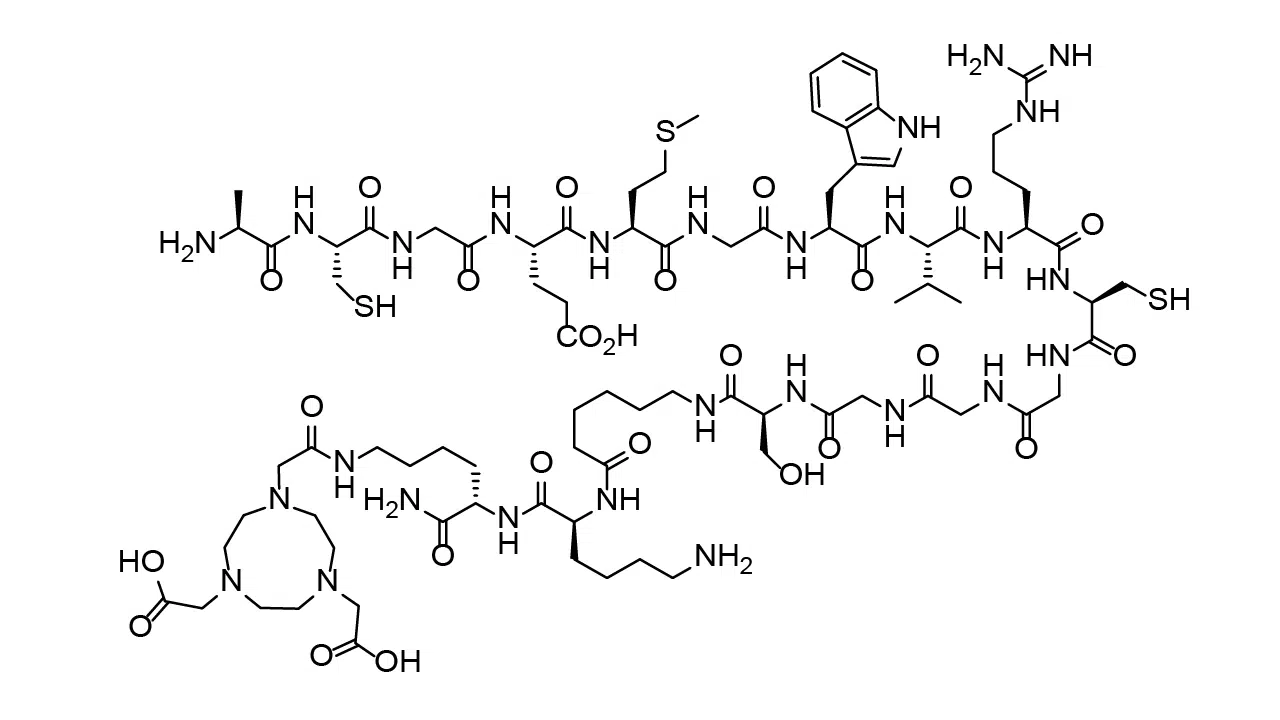
For Ac-225 labeling, the prepared DOTA-Pep-1L (CPC-scientific, San Jose, CA) was incubated with Ac-225 at 70°C for 50 minutes. The TLC plates were scanned on a BioScan Imaging Scanner. Cu-64 was purchased from Washington University in St. Louis. The custom peptide specific to IL13RA2 and a scrambled peptide were conjugated with NOTA by CPC scientific Inc (San Jose, CA). Both the peptides, Pep-1L and scrambled peptide-NOTA were radiolabeled with Cu-64 according to the previously reported methods [15].
Puthenveetil, Sujiet, et al. PloS One 12.5 (2017): e0178452.
- Worldwide Medicinal Chemistry, Pfizer Global R&D, Groton, Connecticut, United States of America.
- Pfizer Oncology Research, Pearl River, NY, United States of America.
"Peptide-payload conjugate (7) was prepared by reacting 2mM aizoacetyl-Ser-Lys-Gly-Ser-Lys (CPC scientific, inc. Sunnywale, CA) with 8 mM NHS-ester payload [19] in 50% Dimethyl sulfoxide (DMSO), 50 mM borate buffer pH 8.5 for 2 h at 37°C."
Kwon, Ester J., et al. Advanced Materials 29.35 (2017).
"[..] synthesized for initial screening with FAM-conjugated lysine at the C-terminal end of the membrane-interactive peptide and with or without D[KLAKLAK]2 on the C-terminus using standard Fmoc chemistry[..] All peptides were synthesized with N-terminal myristic acid and C-terminal amine. [..] larger quantities of the peptides were synthesized by CPC Scientific to 90% purity"