

To date only two entry inhibitors are available, Maraviroc which targets the co-receptor CCR5 3;4 and Enfuvirtide, a peptide drug which interacts with the N-terminal heptad repeat of gp41 of HIV to form an inactive hetero six-helix bundle preventing infection of host cells 5;6. Despite the success achieved with the HAART the emergence of resistant viruses and the side effects of these therapies highlight the need of novel anti-retroviral agents to overcome these problems.
Abstract
One of the most critical requirements of the infection of the human immunodeficiency virus type 1 (HIV-1) is the interaction of its surface envelope glycoprotein gp120 with the cellular receptor CD4, which initiates virus entry to cells. Therefore, envelope glycoprotein gp120 has been validated as a potential target to develop HIV-1 entry inhibitors. Here we report the evaluation of a novel non-natural amino acid, termed 882376, reported earlier as a precursor of a CD4-mimetic miniprotein, as HIV-1 entry inhibitor. 882376 showed HIV-1 inhibitory activity against a large panel of primary isolates of different subtype. Moreover, genotyping of 882376 resistant HIV-1 virus revealed three amino acid substitutions in the gp120 including one in the CD4 binding site suggesting that this molecule may bind to gp120 and prevent its binding to CD4. Additional neutralization experiments indicate that 882376 is not active against mutant pseudoviruses carrying the amino acid substitutions S375H and S375Y located in the “Phe43 cavity” which is the major site of CD4 binding, suggesting that this compound may interfere with the interaction between gp120 and CD4. The unnatural amino acid, 882376, is expected to serve as a lead for further optimization to more potent HIV-1 entry inhibitors.
SOCIAL MEDIA
Connect with us and stay updated by following our social media channels.
Latest Briefings from our Knowledge Center
Press Releases, Industry News, Articles, and Technical Content
Kategaya, L., Di Lello, P., Rougé, L., Pastor, R., Clark, K.R., Drummond, J., Kleinheinz, T., Lin, E., Upton, J.P., Prakash, S. and Heideker, J. Nature 550.7677 (2017): 534.
- Departments of Discovery Oncology, Early Discovery Biochemistry, Structural Biology, Discovery Chemistry, Biochemical and Cellular Pharmacology, Protein Chemistry, Microchemistry, Proteomics, and Lipidomics, Research Pathology, Bioinformatics and Computational Biology, and Translational Oncology, Genentech, South San Francisco, 94080, California, USA
- Department of Pharmaceutical Chemistry and Small Molecule Discovery Center, University of California, San Francisco, San Francisco, 94143, California, USA
- MRC Protein Phosphorylation and Ubiquitylation Unit, School of Life Sciences, University of Dundee, Dundee, DD1 5EH, UK
- Institute for Cell and Molecular Biosciences, Newcastle University, Newcastle upon Tyne, NE2 1HH, UK
"The 5-TAMRA (5-carboxytetramethylrhodamine) peptide was generated by CPCScientific consisting of the sequence 5-TAMRA-YPYDVPDYAIREIVSRNKRRYQEDG.."

Boehm, M., Beaumont, K., Jones, R.M., Kalgutkar, A.S., Zhang, L., Atkinson, K., Bai, G., Brown, J.A., Eng, H., Goetz, G.H. and Holder, B.R. Journal of Medicinal Chemistry (2017).
- Pfizer Worldwide Research & Development, Cambridge, Massachusetts 02139, United States
- Pfizer Worldwide Research & Development, Groton, Connecticut 06340, United States
The chemokine receptor CXCR7 is an attractive target for a variety of diseases. While several small-molecule modulators of CXCR7 have been reported, peptidic macrocycles may provide advantages in terms of potency, selectivity, and reduced off-target activity
Bainbridge, Travis W., et al. Scientific Reports 7.1 (2017): 12524.
- Protein Chemistry, Molecular Oncology, Discovery Chemistry, Cancer Immunology, and Neuroscience. Genentech Inc., South San Francisco, CA, 94080, USA
"ANP FAP and aP NIRF were synthesized by CPC Scientific (Sunnyvale, CA)… Another internally-quenched FRET peptide substrate (ANPFAP) for FAP has recently been reported and demonstrated for use as an activity-based, in vivo imaging tool. The peptide sequence contains two internal Gly-Pro dipeptide motifs, susceptible to FAP cleavage and a Cy5.5/QSY21, quenched-FRET pair."
Coorens, Maarten, et al. The Journal of Immunology 199.4 (2017): 1418-1428.
"CATH-2 and LL-37 were synthesized by Fmoc-chemistry at CPC Scientific (Sunnyvale, CA)."
Tcholakov, I., Grimshaw, C.E., Shi, L., Kiryanov, A., Murphy, S.T., Larson, C.J., Plonowski, A. and Ermolieff, J. Bioscience Reports 37, no. 3 (2017): BSR20170275.
- Departments of In Vitro Pharmacology, Immunology, Enzymology and Biophysical Chemistry, Medicinal Chemistry, External Innovation, Metabolic Disease, In Vitro Pharmacology, and Gastrointestinal and Enterology Discovery Unit, Takeda California, Inc., 10410 Science Center Drive, San Diego, CA 92121, U.S.A
The substrate used for our PHD2 kinetic study was a 17-mer peptide mimicking the sequence of HIF-1a surrounding the Pro564 residue hydroxylated by the PHD enzymes (Biotin-DLEMLAPYIPMDDDFQL). The substrate used for FIH1 was a 34-mer peptide mimicking the sequence of HIF-1α surrounding residue Asn803 (DESGLPQLTSYDCEVNAPIQGSRNLLQGEELLRAL). Both peptides were synthesized by CPC Scientific Inc.
Wilson, Sarah S., et al. PLoS Pathogens 13.6 (2017): e1006446.
"Cryptdin 2 (UniProtKB: P28309, LRDLVCYCRTRGCKRRERMNGTCRKGHLMYTLCCR)... obtained by oxidative refolding of partially purified linear peptides (synthesized by CPC Scientific...) and purifying the correctly folded species by reverse-phase high-pressure liquid chromatography (RP-HPLC). Purity was determined by analytical RP-HPLC, and the mass of the disulfide-bonded peptides was verified by high mass accuracy liquid chromatography-mass spectrometry."
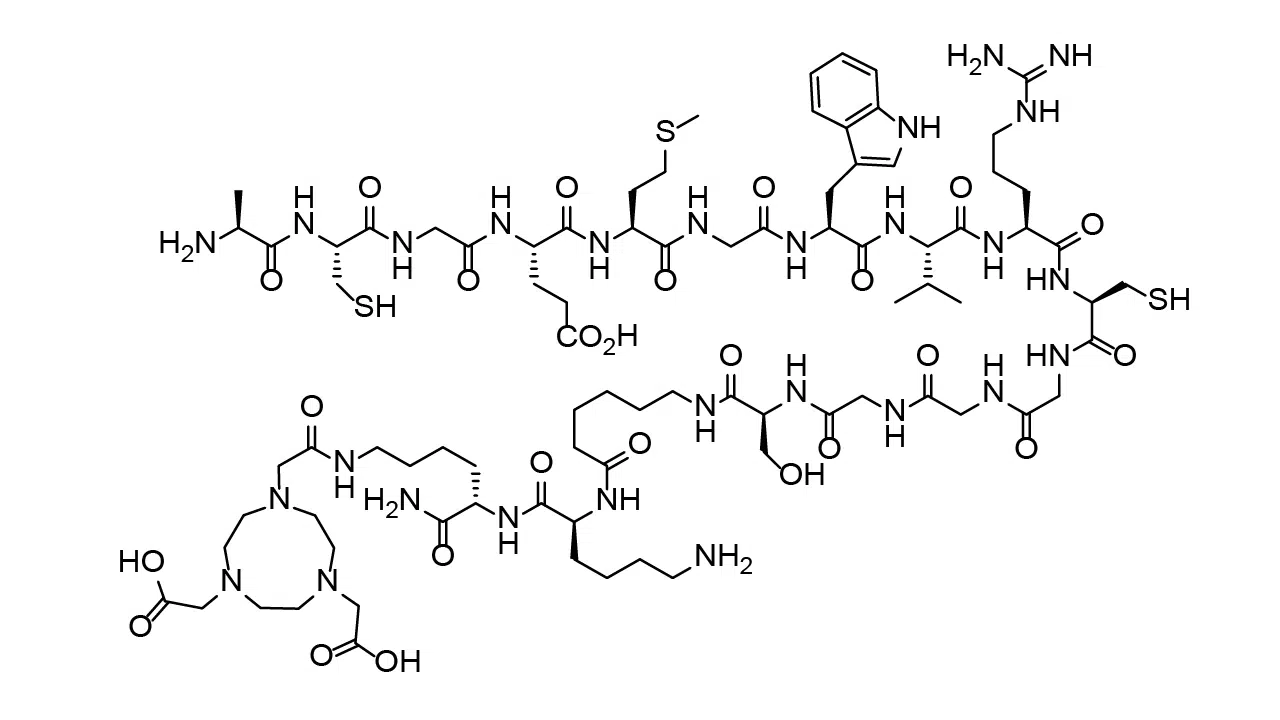
Sattiraju, A., et al. Oncotarget 2017, 8 (26), 42997-43007.
For Ac-225 labeling, the prepared DOTA-Pep-1L (CPC-scientific, San Jose, CA) was incubated with Ac-225 at 70°C for 50 minutes. The TLC plates were scanned on a BioScan Imaging Scanner. Cu-64 was purchased from Washington University in St. Louis. The custom peptide specific to IL13RA2 and a scrambled peptide were conjugated with NOTA by CPC scientific Inc (San Jose, CA). Both the peptides, Pep-1L and scrambled peptide-NOTA were radiolabeled with Cu-64 according to the previously reported methods [15].
Puthenveetil, Sujiet, et al. PloS One 12.5 (2017): e0178452.
- Worldwide Medicinal Chemistry, Pfizer Global R&D, Groton, Connecticut, United States of America.
- Pfizer Oncology Research, Pearl River, NY, United States of America.
"Peptide-payload conjugate (7) was prepared by reacting 2mM aizoacetyl-Ser-Lys-Gly-Ser-Lys (CPC scientific, inc. Sunnywale, CA) with 8 mM NHS-ester payload [19] in 50% Dimethyl sulfoxide (DMSO), 50 mM borate buffer pH 8.5 for 2 h at 37°C."
Kwon, Ester J., et al. Advanced Materials 29.35 (2017).
"[..] synthesized for initial screening with FAM-conjugated lysine at the C-terminal end of the membrane-interactive peptide and with or without D[KLAKLAK]2 on the C-terminus using standard Fmoc chemistry[..] All peptides were synthesized with N-terminal myristic acid and C-terminal amine. [..] larger quantities of the peptides were synthesized by CPC Scientific to 90% purity"